Grumpy Pufferfish in Teacup Sticker
First Impressions: A Mood, Not Just a Motif
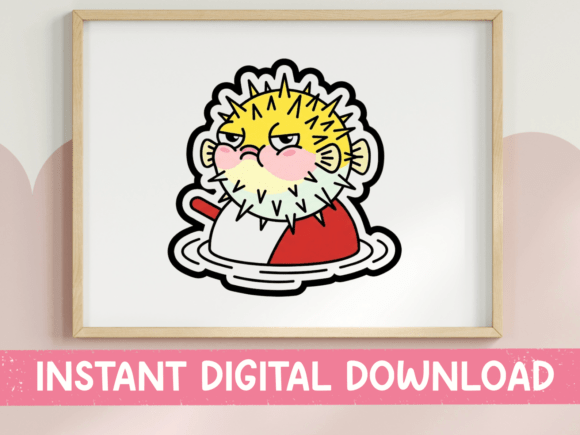
When I opened the Grumpy Pufferfish in Teacup Sticker file, I didn’t just see a graphic—I felt its energy. That round, spiky yellow pufferfish, wedged snugly into a teacup with eyebrows permanently furrowed and fins crossed? It’s dry, it’s relatable, and it’s instantly memorable. As a designer who’s stitched hundreds of whimsical motifs for boutique clients and Etsy sellers, I immediately pictured this on a heavyweight organic cotton tote—something meant to hold groceries *and* attitude. The composition is tight and centered, with generous negative space around the cup. That’s not accidental—it’s embroidery-friendly by instinct.
Where This Design Actually Shines in Real Projects
I tested the Grumpy Pufferfish in Teacup Sticker on a custom embroidered sweatshirt for a local coffee shop’s staff gift line—and it landed perfectly. The rounded shape translated cleanly into satin-stitched cup edges and controlled fill-stitch fish scales. Because the design avoids fine linework or micro-details (no tiny steam curls, no delicate handle filigree), it held up beautifully at 3.5" wide on midweight fleece. It also worked well as an embroidered patch on denim aprons—sturdy, expressive, and just quirky enough to spark conversation without overwhelming the garment.
For baby embroidery? Proceed with care—but not dismissal. On a soft cotton onesie, I resized it to 2.25" and swapped dense fill for lighter underlay + open satin stitch on the cup rim. The grumpiness softened into gentle charm, and parents loved the unexpected humor. Same goes for holiday embroidery: stitched onto linen tea towels or pillow covers, it adds personality without seasonal cliché. As a T-Shirt Designs asset, it’s strongest on crewnecks and relaxed-fit tees—not performance fabrics—where its bold silhouette reads clearly even from across a room.
Where to Pause—and Plan Ahead
This isn’t a one-size-fits-all embroidery file. Its charm relies on contrast and clarity—so avoid it on heavily textured fabrics like bouclé or thick terry cloth unless you’re using heavy cutaway stabilizer and reducing stitch density manually. On dark fabric, test thread colors thoroughly: that yellow pufferfish needs warmth but not neon; try golden ochre or muted mustard instead of safety yellow for richer depth. And skip curved surfaces like structured caps unless you’ve confirmed the design fits comfortably within your hoop’s usable diameter—those cup curves can distort if stretched too tightly.
Also note: while the sticker version implies flat simplicity, translating Grumpy Pufferfish in Teacup Sticker into a machine embroidery design means checking for overlapping elements, stitch direction logic, and jump stitch placement. If you’re turning it into an applique design, the cup outline should cleanly separate from the fish—no shared paths. And never assume licensing covers commercial use; verify whether this Graphics file permits resale of finished embroidered products or digital embroidery files before listing on Etsy or bundling for craft fairs.
Design Notes Every Embroiderer Should Run Through
- Test first on scrap fabric—especially if stitching on knits or lightweight cotton. Watch how the fish’s spikes behave with tension.
- Review stitch density before finalizing. Too dense = stiff, bulky results; too sparse = loss of expression. Aim for balanced fill in the cup, slightly looser in the fish body.
- Confirm hoop size compatibility. At standard sizes (3"x3" or 4"x4"), it fits comfortably—but double-check if your machine requires centering offsets.
- Inspect small details in your embroidery software: are the eyes distinct? Does the teacup handle read as a single clean curve? If not, simplify before stitching.
- Mock it up in black and white—this reveals contrast issues fast. Does the grump still read when color is stripped away?
- Compare light vs. dark fabric backgrounds visually. Some yellow threads fade on cream; others pop on navy. Swatch both.
- Use appropriate stabilizer: medium tear-away for stable wovens, cutaway for knits or stretchy blends.
- Verify dual-use readiness: Does it work equally well for personal gifts *and* your small shop’s branded merchandise? If yes—it’s versatile. If not, adjust scale or detail level.
Why This Design Builds Trust—Not Just Cuteness
In my decade of reviewing embroidery assets for craft businesses, I’ve learned customers don’t buy motifs—they buy feeling, reliability, and intention. The Grumpy Pufferfish in Teacup Sticker delivers that. It signals wit without irony, craftsmanship without fuss. When stitched cleanly on a handmade product, it tells buyers: “This wasn’t slapped on. Someone thought about how it lives on fabric.” That perception lifts perceived value, encourages repeat orders, and makes personalized gifts feel genuinely considered—not generic. For Etsy sellers, it’s a quiet differentiator in saturated markets like nursery decor or teacher appreciation items. For boutique owners, it reinforces brand voice: warm, human, lightly irreverent.
Final Thought: It’s Not Just a Graphic—It’s a Conversation Starter
I recently added the Grumpy Pufferfish in Teacup Sticker to a set of embroidered kitchen towels for a client’s wedding gift suite. Guests kept asking, “Is that *her*?!”—not because it looked like the bride, but because the expression was so unmistakably *human*. That’s the quiet power of this design: it doesn’t shout. It smirks. And in embroidery—where every stitch carries weight—that kind of subtlety is rare, valuable, and deeply wearable. Use it where personality matters more than polish. Stitch it where people pause, smile, and say, “Oh—*yes.*”