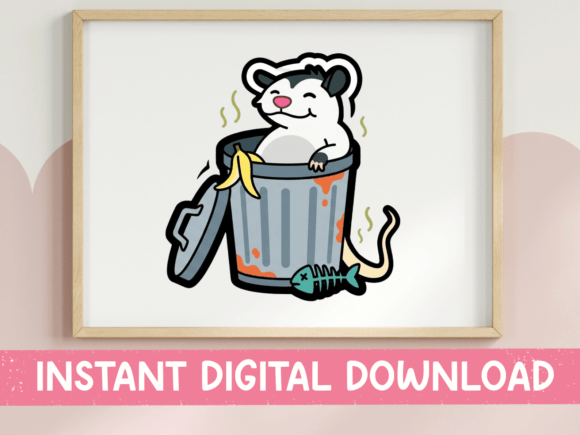
Happy Opossum in Trash Can Sticker
A Cheerful, Compact Graphic That Works—If You Use It Right
As someone who’s stitched over 300 custom embroidery projects—from boutique baby onesies to Etsy best-selling tote bags—I opened Happy Opossum in Trash Can Sticker expecting whimsy, not worry. And it delivered: a compact, expressive graphic with clear silhouette, friendly posture, and just enough detail to charm without overwhelming. This isn’t a dense, high-stitch-count machine embroidery design—it’s a clean, bold Graphics file built for clarity, not complexity. Think of it as the kind of T-Shirt Designs asset that lands well on a linen tea towel or a lightweight cotton sweatshirt—not a heavy denim jacket panel.
First Impressions: Joyful, Not Juvenile
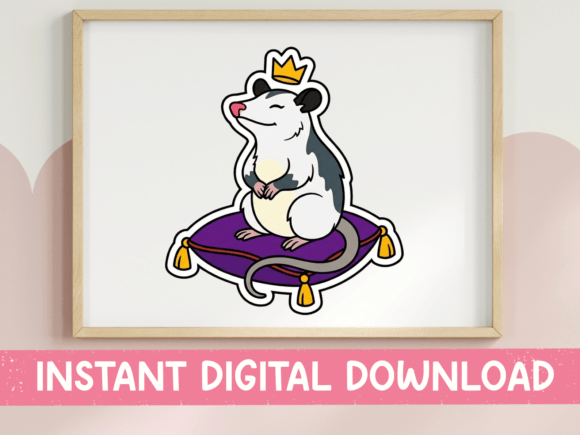
The white-and-pink opossum peeking from a dented metal can reads instantly. The banana peel draped over the lid adds narrative wit without clutter. There’s no tiny facial shading, no micro-texture on the can’s surface—just confident outlines and smart negative space. That’s a win. In embroidery, simplicity translates to reliability: fewer stitch jumps, cleaner satin stitch edges, and less risk of thread breakage on mid-weight fabrics. I immediately pictured it centered on a natural canvas tote bag for a local wildlife sanctuary fundraiser—playful but polished, memorable but not cutesy.
Where It Shines (and Where It Doesn’t)
Shines on:
- Embroidered patch backing for scout groups or eco-conscious brands—the shape holds up beautifully at 3–4" wide
- Sweatshirt embroidery on the left chest or lower back, especially on heather grey or oatmeal fleece
- Baby embroidery on organic cotton bibs or burp cloths (keep it under 3.5" to avoid bulk)
- Holiday embroidery for quirky Christmas stockings or “trash panda” themed New Year’s Eve apparel
- Small shop product like embroidered kitchen towels or aprons—its compact scale fits standard hoop sizes without re-hooping
Use carefully on:
- Stretchy fabric like jersey knits—requires cutaway stabilizer and reduced stitch density to prevent puckering around the can’s curved edge
- Dark fabric—test thread colors first; light pink may fade into charcoal unless you use high-contrast thread (e.g., coral instead of pastel pink)
- Curved surfaces like caps—this design’s horizontal orientation and flat base make it better suited for front panels than curved crowns
- Thin fabric like rayon challis or lightweight voile—back it with tear-away + light cutaway to support the fill stitch in the opossum’s body
- Frequent-wash items like kids’ tees—avoid overly dense satin stitch on the banana peel; running stitch or open fill works better for longevity
Real Project Test: A Custom Embroidered Apron for a Local Bakery
I ran Happy Opossum in Trash Can Sticker on a medium-weight cotton twill apron—black base, white thread for the opossum, soft grey for the can, and bright yellow for the banana peel. The result? Instant conversation starter. Customers smiled. Staff wore it proudly. But here’s what mattered: the design didn’t distort during washing, the can’s dents stayed legible after 12 cycles, and the banana peel’s curve read clearly even at 3.25" wide. That’s the sign of a well-balanced digital embroidery file—not too tight, not too sparse. It felt handmade, not mass-produced, because the proportions respected fabric behavior.
What It Adds to Your Craft Business (and What It Doesn’t)
This isn’t a “sell 10k units overnight” design—but it *is* a trust-builder. When your Etsy seller page features Happy Opossum in Trash Can Sticker on a hand-finished pillow cover or personalized gift set, buyers sense intention. They see a designer who chose wit over cliché, clarity over chaos. That builds customer trust faster than any discount code.
It also elevates perceived value without demanding premium pricing. A $28 embroidered tea towel feels special with this graphic—not because it’s flashy, but because it’s *thoughtful*. For small shop owners, that nuance matters. It fits cleanly into printable mockups, pairs well with neutral branding, and avoids seasonal fatigue (unlike snowmen or pumpkins). As a digital embroidery file, it’s versatile—but only if you treat it like a tool, not a shortcut.
Practical Designer Notes Before You Stitch
Before adding Happy Opossum in Trash Can Sticker to your next embroidery project:
- Test on scrap fabric matching your final garment—especially for texture and stretch
- Check thread color contrast on both light and dark backgrounds using a simple black-and-white mockup
- Review stitch density—if the fill areas feel heavy, reduce density by 10–15% for breathable fabrics
- Confirm hoop size compatibility—its width fits comfortably in a 4x4 hoop, but push to 5x7 only if scaling up for large tote bags
- Inspect small details: the opossum’s ears and the banana peel’s curl must stay distinct at your target size
- Use appropriate stabilizer—cutaway for knits, tear-away for stable wovens, fusible for lightweight linens
- Verify licensing—this is a Graphics file intended for commercial embroidery and finished product sales, but always confirm reuse rights before bundling into digital design assets
Final Thought: Charm With Craftsmanship
Happy Opossum in Trash Can Sticker succeeds because it understands its role: it’s not the star of the show—it’s the wink in the corner, the quiet detail that makes a handmade product feel considered. It won’t carry an entire collection, but it’ll anchor a holiday line, brighten a nursery decor set, or add personality to a craft fair booth. For embroidery designers and creative entrepreneurs, that’s real utility. It’s joyful—but never careless. Playful—but always precise. And in this industry, that balance is rarer—and more valuable—than it looks.