Humpback Whale Breaching Sticker
A Designer’s First Glance: Bold, Fluid, and Instantly Recognizable
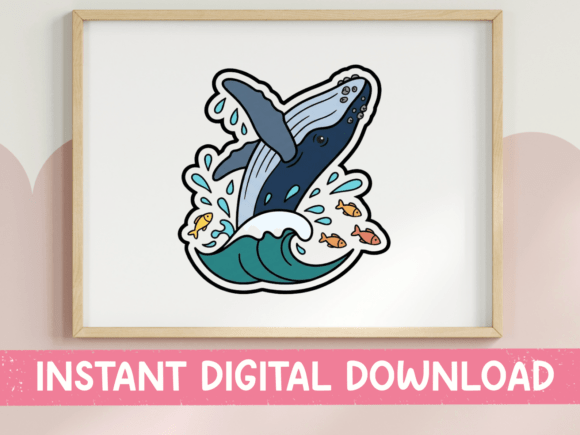
When I opened Humpback Whale Breaching Sticker for the first time, what struck me wasn’t just the marine theme—it was the *rhythm*. The dark navy and slate-blue whale arcs cleanly over a teal cresting wave, water droplets implied with just three or four crisp, energetic shapes. There’s no clutter, no forced symmetry—just motion, depth, and quiet confidence. As a designer who’s stitched hundreds of ocean-themed pieces for boutique clients and Etsy sellers, I immediately pictured this on a heavyweight organic cotton tote bag: clean, uncluttered, and unmistakably handmade.
Where This Design Truly Shines in Real Embroidery Projects
Humpback Whale Breaching Sticker is built for impact—not intricacy. That makes it ideal for custom apparel where clarity matters more than fine detail: sweatshirt embroidery on midweight fleece, baby embroidery on soft jersey onesies (with gentle stabilizer), or embroidered patches sewn onto denim aprons or canvas backpacks. I recently used a similar layout for a coastal nursery line—this design would slot right in as a pillow cover motif or tea towel centerpiece. Its graphic simplicity translates beautifully to holiday embroidery too: think navy linen stockings or personalized beach-themed wedding favors.
For craft businesses and Etsy sellers, this works especially well as a digital embroidery file paired with a printable mockup. Customers love seeing how bold, confident designs like Humpback Whale Breaching Sticker pop on light fabric—and how gracefully they scale down without losing legibility. It reads instantly at 3.5 inches wide, holds up well at 5 inches, and still feels intentional even when resized for a cap front (though curved surfaces demand extra stabilizer attention—more on that soon).
What to Watch For: Practical Limits & Fabric Realities
This isn’t a design for ultra-fine work. If you’re planning baby embroidery on gauzy muslin or delicate silk-blend scarves, tread carefully—the wave’s edge and droplet shapes rely on clean stitch definition. On thin or stretchy fabric, fill stitch density could cause puckering unless paired with cutaway stabilizer and reduced tension. Likewise, dense satin stitch areas (like the whale’s curve) may need slight digitizing tweaks for dark fabric backgrounds to avoid thread shine overwhelming contrast.
Curved surfaces—caps, bucket hats, or rounded pillow corners—require thoughtful placement. The whale’s upward leap naturally draws the eye, but if hooped too high on a crown, the wave may distort. Always test Humpback Whale Breaching Sticker on scrap fabric first, especially when using textured fabrics like terry cloth towels or looped kitchen linens. Those tiny orange accents? They’ll vanish on busy prints or low-contrast thread—so confirm your thread colors against the base fabric before stitching your first finished product.
Why This Design Builds Trust—Not Just Aesthetics
Customers don’t buy “a whale.” They buy a feeling: calm strength, joyful movement, quiet reverence for the sea. Humpback Whale Breaching Sticker delivers that emotionally, without leaning on clichés or cartoonish exaggeration. That authenticity elevates handmade product perception—especially for small shop owners curating coastal or nature-inspired collections. When used consistently across tote bags, sweatshirts, and embroidered patches, it reinforces brand consistency without needing logos or slogans. And because it avoids tiny lettering or fragile details, it maintains professionalism through repeated washing—a key factor for parents buying baby embroidery or gift buyers choosing holiday embroidery.
Designer Notes You’ll Actually Use
- Test before you commit: Run Humpback Whale Breaching Sticker on scrap fabric matching your final project’s weight, weave, and color.
- Check thread color contrast: Navy + teal + orange works vividly on cream or heather grey—but verify on black or charcoal; orange may mute without metallic or high-sheen thread.
- Review stitch density: High-density fill areas should lie flat on stable fabrics, but reduce density slightly for knits or lightweight cottons.
- Confirm hoop size early: This design fits comfortably in a 4x4 hoop, but if scaling beyond 5 inches, double-check jump stitches and underlay coverage.
- Inspect small details: Those water droplets? They’re likely running stitch or short satin elements—ensure they’re legible at your intended size.
- Mock it in black and white: Helps spot value contrast issues before stitching—especially important for commercial embroidery projects sold online.
- Use proper stabilizer: Medium-weight cutaway for knits, tear-away for stable wovens, and fusible + tear-away combo for textured tea towels or aprons.
- Licensing matters: Since this is listed under T-Shirt Designs and Graphics, confirm whether the embroidery file permits commercial use, resale of finished products, or inclusion in digital embroidery bundles.
Final Thought: A Thoughtful Anchor in Your Design Toolkit
Humpback Whale Breaching Sticker won’t solve every embroidery challenge—but it solves a very specific, valuable one: delivering strong visual identity with minimal fuss. It’s the kind of machine embroidery design that looks equally at home on a $280 boutique sweatshirt and a $24 handmade tote, because its balance feels intentional, not automated. For craft business owners building cohesive collections—or designers selecting embroidery file assets for long-term use—it’s less about trend-chasing and more about having a reliable, emotionally resonant anchor. Whether you’re prepping for a craft fair, updating your Etsy listings, or sourcing design assets for client work, this is one graphic that earns its place—not just on fabric, but in your workflow.