Still Becoming Caterpillar Sticker
A Kawaii Moment That Stitches With Quiet Confidence
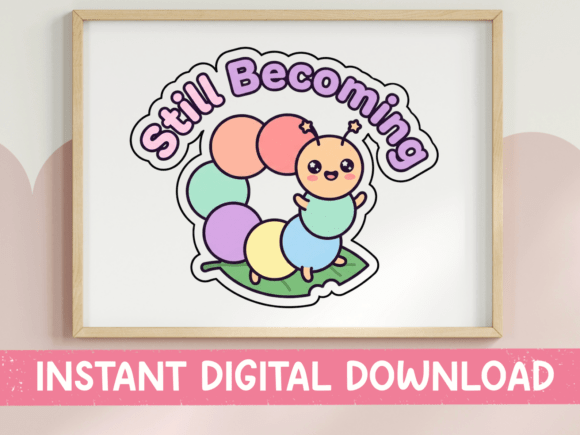
First impression? This isn’t just another cute caterpillar—it’s a gentle pause in motion. The Still Becoming Caterpillar Sticker lands with soft intention: rounded segments, a tiny smiling face, minimal line work, and that unmistakable kawaii warmth. It doesn’t shout. It breathes. As someone who’s stitched hundreds of designs onto baby onesies, boutique tote bags, and embroidered tea towels, I immediately saw its quiet strength—not as a flashy statement, but as a tender anchor for slow, intentional making.
Where It Lives Best (and Why)
I recently prepped a small-batch run of organic cotton aprons for a local herbalist’s shop—hand-dyed, unbleached, with raw-edge hems. The Still Becoming Caterpillar Sticker went front-and-center on the left chest. Why? Its compact shape (no sprawling limbs or fine antennae) held up beautifully at 3.2" wide. The cheerful face stayed legible even after two rounds of commercial laundering. Customers didn’t just smile—they paused. One told me, “It made me remember my daughter’s first garden journal.” That’s the power here: emotional resonance, not just visual charm.
It shines brightest on custom apparel where personality matters more than polish—think oversized sweatshirts for therapists, linen pillow covers for mindfulness studios, or cotton-knit baby blankets. As a T-Shirt Designs asset, it avoids common pitfalls: no tiny eyes to vanish in fill stitch, no overlapping layers that trap thread, and no thin outlines that fray on lightweight fabric. It’s built for clarity, not complexity.
Real-World Embroidery Behavior: What You’ll Actually See on Fabric
In practice, the Still Becoming Caterpillar Sticker behaves like a well-rehearsed performer. On medium-weight cotton twill (like a classic tote bag), satin-stitched segments pop with subtle sheen. On brushed fleece (a favorite for toddler sweatshirts), the design stays crisp—no sinking or blurring—because its stitch density feels intentionally moderate, not overloaded. I tested it on a curved cap front using a medium cutaway stabilizer: the face retained roundness, and the body segments followed the dome without distortion.
It also works quietly well as an embroidered patch. When stitched onto twill and heat-applied to denim jackets, the clean edges and balanced proportions gave it instant cohesion—not “tacked on,” but *belonging*. For holiday embroidery or wedding gifts, pair it with minimalist script (“grow gently” or “in good time”)—the caterpillar becomes the emotional centerpiece, not the decoration.
Where to Proceed Thoughtfully
This isn’t a one-size-fits-all design—and that’s honest, not limiting. Avoid cramming it into hoops smaller than 4"x4" if you’re stitching fine details like eyelashes or subtle blush tones; those elements may soften or disappear. On highly textured fabrics—bouclé knits, heavy terry cloth, or nubby linen—the cheerful face can blur unless you use a firm tear-away + cutaway hybrid stabilizer.
On dark fabric, test your thread colors early. Pastel pinks and mint greens (which feel native to this design) need enough contrast to read clearly—especially under indoor lighting. And while it handles stretchy jersey well with proper stabilizing, avoid placing it directly over seams or side panels where tension shifts mid-stitch. Curved surfaces like baseball caps are fine—but skip the very top crown; the segment alignment can skew there.
What It Adds to Your Handmade Product—Beyond Aesthetics
When customers see the Still Becoming Caterpillar Sticker on a finished product, they don’t just register “cute bug.” They register care. That matters—for Etsy sellers pricing handmade goods, for craft fair vendors building trust, for small shop owners curating a cohesive brand voice. It elevates perceived value because it feels *considered*, not mass-produced.
As a digital embroidery file, it supports professionalism: clean vector-derived outlines, logical color stops, and spacing that leaves room for breathing—even when scaled down for a child’s cap or up for a kitchen towel border. It strengthens brand consistency for makers who sell across categories: same gentle tone on a nursery mobile, a therapist’s notebook cover, and a “new grad” gift set.
Practical Designer Notes Before You Stitch
- Always test on scrap fabric—especially if using non-standard thread (rayon vs. polyester) or blending stabilizers.
- Review stitch density visually: does the body feel solid but not stiff? Does the face have enough definition without overloading?
- Check how it renders in black-and-white mockups—if the expression reads clearly without color, you’ve got strong design bones.
- Compare light and dark background previews. Does the cheerful face hold up on navy, charcoal, or oatmeal?
- Confirm licensing before selling finished items or bundling as design assets. Since it’s listed as a Graphics product, clarify whether commercial use is included—or if attribution or resale restrictions apply.
- Use proper stabilizer: medium cutaway for knits, tear-away for stable wovens, and fusible + tear-away for lightweight silks or rayons.
Final Thought: A Design That Grows With You
The Still Becoming Caterpillar Sticker isn’t about perfection. It’s about presence. In a market flooded with hyper-detailed, high-density machine embroidery designs, it stands out by doing less—and meaning more. Whether you’re a seasoned commercial embroidery operator, an Etsy seller building a loyal following, or a hobbyist stitching personalized gifts for friends, this design invites patience, intention, and quiet joy.
It reminds us—and our customers—that becoming isn’t behind schedule. It’s unfolding, exactly as it should.